Wednesday, May 1, 2013

Trent Park and Candid German Generals


Watch Bugging Hitler's Soldiers on PBS. See more from Secrets of the Dead.
One of the most exciting things that a historian can have happen to them is to discover something that had been lost to history and adds to the understanding of an event. Such is the case with the discovery of 50,000 pages of transcripts from secretly recorded conversations between captured German generals about various aspects of the war.

As the episode of "Secrets of the Dead" describes, great trouble was expended to catch the German generals that the British had captured in giving away some morsel of important information in casual conversation that could change the course of the war. Such information included the confirmation of the existence of the V-2 rockets, the deep divide between the Germans loyal to Hitler and those who weren't, and tragically the deep extent of the Holocaust atrocities.

These files had been buried because the British did not want to reveal the effectiveness of their surveillance techniques in the atmosphere of the Cold War. They were recently rediscovered by accident by a German historian in the Royal Archives in London. This is what historians mean when we say that we aren't done making discoveries about the war, we haven't learned all there is to know about the war, and this is very exciting for us. Until next time take care, and thanks for reading.

Stars and Stripes Review: May 6, 1945

Scanned by Cody Lizotte.
This issue of The Stars and Stripes is interesting in that it was published two days before Germany's surrender, known as V-E Day (Victory in Europe). Of course, at that time they didn't know the exact day the Germans were going to surrender. After all, the Germans had been facing their ultimate defeat for the last two years, ever since the Germans lost their strategic offensive capability on the Eastern Front.

As shown in the headline, the Germans were still fighting like warriors right up to the end. Their last pocket of armed resistance was growing smaller and smaller. Elsewhere on the continent, the war was not over yet. German forces had captured Norway in 1940 and now that Germany was effectively in Allied hands this is where the leaders of German resistance were holed up, including Grand Admiral Karl Doenitz, the successor to Hitler after his April 30 suicide. In the article on Norway, it mentions that Swedish officials regarded rumors of German capitulation in Norway to be "premature". Little did they know...

Of course, the fighting was still far from over in the Pacific, where V-J Day wouldn't come until August of 1945. However, for a historian looking back on this issue, it's cool to see the reports of continued German resistance and to think that the people who wrote those articles had no idea that the war in Europe was that close to being over. Until next time take care, and thanks for reading.

Tuesday, April 30, 2013

The Main Challenge For World War II Historians

One of the greatest questions that historians face in any field of study is "what was this person thinking before X happened?" Often times historians are forced to make educated guesses based on the person's actions as to what their motivations are.

However, sometimes historians have documentation from a person to give us a glimpse into their mindset during an event. In the field of World War II research, we are fortunate to have some very interesting and enlightening perspectives into two of the war's combatants: Britain and Germany.

Of course, the person that people most want to get into the mind of is Adolf Hitler. Fortunately for historians, Hitler was an avid orator and there are numerous works of his that explain his motivations. People who at the time viewed Germany's aggressive actions as a shock obviously didn't read "Mein Kampf", in which Hitler states that:

"[the Nazi movement] must find the courage to gather our people and their strength for an advance along the road that will lead this people from its present restricted living space to new land and soil, and hence also free it from the anger of vanishing from the earth or of serving others as a slave nation."

Friday, April 26, 2013

Arado Ar 234: First Jet Bomber

File:Arado 234B 2.jpg
An Arado Ar 234 after the war with US markings.
Photo sourced from WikiCommons.
As World War II neared its conclusion in Europe, the Germans were growing increasingly desperate for "wonder weapons", weapons that could turn the tide of war in their favor. Nothing the Germans developed did that but they greatly advanced the field of military technology. One of these technological innovations was the implementation of the jet engine in both fighters and bombers. The fighter was the Messerschmitt Me 262, the bomber was the Ar 234.

The first Ar 234s were introduced in the fall of 1944. At first they were only used in a reconnaissance capacity, but soon they were used as bombers. Since the bomb bay was completely filled with fuel tanks, the bombs had to be mounted externally, an unusual trait for such a plane. Even so, the few missions the Ar 234 flew proved that the plane was nearly impossible to catch (see Bombing of Remagen Bridge)

However, like all of Germany's secret weapons it was too little too late. The early jet engines needed a lot of fuel that wasn't available and Allied pilots figured out that the easiest time to shoot down a jet was to wait for it to take off or land, which happened on many occasions. Nevertheless, the innovations made by the Germans in the field of jet aircraft paved the way for all modern jet aircraft today. Until next time take care, and thanks for reading.

(Fcts sourced from "The Encyclopedia of Aircraft of World War II" edited by Paul Eden as well as Wikipedia on the Ar 234)

Wednesday, April 24, 2013

WWII Movie Review: "A Bridge Too Far"

Photo sourced from
WikiCommons.
It was the largest operation on the Western Front since the D-Day landings. It was the largest airborne assault in history up to that time. It was also the big disappointment for the Allies who thought that they could end the war before Christmas 1944. This was Operation Market Garden, and it was immortalized by the 1977 film A Bridge Too Far based on the 1974 book by Cornelius Ryan.

The film is famous as a movie because of its large number of all-star actors, including James Caan, Robert Redford, Michael Caine, John Ratzenberger, Laurence Olivier,  and Sean Connery. This was not the first World War II film to feature some of these names in one place (see The Longest Day).

However, as a historical film it outdoes itself. Based on the book of the same name by Cornelius Ryan, this movie is incredibly accurate in its portrayal of the ultimate failure of Market Garden and the people associated with it on both sides, with few obvious artistic liberties.  Filming for the most part took place on the sites where the actual events happened, most notably the Arnhem bridge.

This is not the shortest film at almost 3 hours, but for the time you commit to watching this it gives you a good taste of one of the most notorious campaigns in World War II and overall it's a great war movie. Until next time take care, and thanks for reading.

Saturday, April 20, 2013

The Bridge at Remagen: First Jet Bomber Target in History

An Arado Ar 234 as seen at the National Air and Space Museum's
Steven Udvar-Hazy Center. Photo by Cody Lizotte.
In early 1945, the majority of Germans all but knew they were done for. The Luftwaffe's attempts to break the Western Allied air forces, Operation Bodenplatte, was a disaster. Soviet troops had captured almost all of occupied Poland and were closing on Berlin. Finally, the Western allies had reached the Rhine River, the natural border between France and Germany.

The Wehrmacht (German army) had failed in their mission to blow up the main bridge across the river at Remagen, so the Luftwaffe (German air force) was ordered to launch bombing strikes to destroy the bridge. Suffice it to say, the Allies were well prepared to fend off air attacks and the strikes were unsuccessful. The Americans captured both sides of the bridge by March 23, 1945.

However, this was the first instance in history when formations of only jets were used to strike a target. The escort fighters were Messerschmitt Me 262s, the world's first operational jet fighter. The bombers were Arado Ar 234s, the world's first jet bomber with a bomb payload equal to that of the B-17 Flying Fortress but with a top speed at least 150mph faster.

The raids may not have been a success, but this early mission would later serve as a blueprint for future air strikes in the jet era, with F-18s escorting A-10s for example. Until next time take care, and thanks for reading.
(Facts sourced from "Campaigns of World War II Day by day" by Chris Bishop and Chris McNab)

Wednesday, April 17, 2013

Luftflotte 4: Lifeline of the German 6th Army at Stalingrad

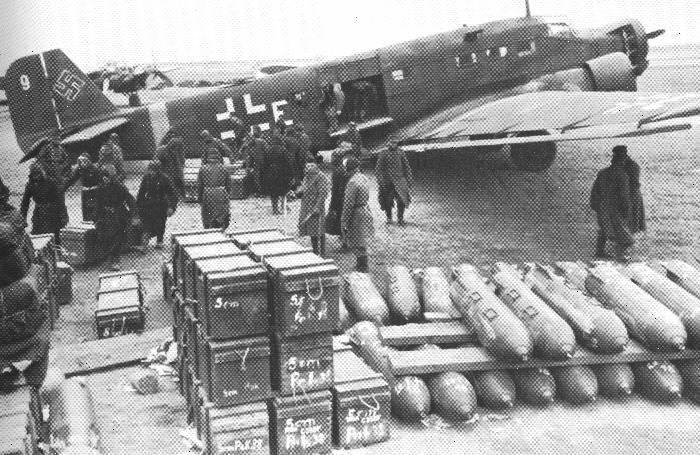
A Junkers Ju52 being offloaded at Stalingrad.
Photo sourced from www.stalingrad.net.
One of the US Air Force's proudest moments in postwar history was the Berlin Airlift, a massive undertaking in which the Soviet-besieged city of West Berlin was supplied solely by air for over a year. A similar feat was attempted during the war by the German Luftwaffe in order to supply the surrounded Sixth Army at Stalingrad.

In 1940, with the British Expeditionary Forces and the remnants of the French army fleeing to the coast near Dunkirk, Hitler ordered the advancing forces stopped. This was partly because they had outrun their supply lines, but also because Herman Goering, the head of the Luftwaffe, promised Hitler that he would demolish the enemy using nothing but air power. Needless to say, it didn't work nearly as well as Goering had hoped.

You would think Hitler would have lost faith in Goering after that, but no. In November of 1942, Goering made a promise to Hitler that using Junkers Ju 52s from Luftflotte 4 he could supply the surrounded Sixth Army with enough resources to drive back the Soviets. This worked in that it allowed the Sixth Army to hold on longer than was expected, but because of increased Soviet air superiority and the fact that the Soviets were capturing the airstrips near Stalingrad meant that the airlift was overall a disaster. The last plane left Stalingrad on January 24, 1943, and the Sixth Army surrendered ten days later.

The toll on Luftflotte 4 was tremendous, with one-third of the entire fleet of Ju-52s on the Eastern Front destroyed. Nevertheless, one good  thing came from this airlift. About 42,000 wounded troops were evacuated and were spared the harsh prisoner of war camps that awaited the remnants of the Sixth Army. Until next time take care, and thanks for reading.

(Facts and figures sourced from "World War II" by H.P Willmott, Robin Cross, and Charles Messenger as well as Wikipedia on Hans-Georg von Seidel, the Luftwaffe head of logistics during this operation.)