Wednesday, November 2, 2011

Anzio: The "Stranded Whale" of the Italian Campaign

Allied forces landing in late January 1944
It's early 1944, and the tide of war is starting to swing in the Allies' favor. The Normandy landings are still in the planning phase, but Stalin begs the Allies to open another European front to take pressure of the Soviet Union. Italy is chosen as the "soft underbelly" of Hitler's Europe, as Winston Churchill put it. However, the campaign to sledgehammer up the Italian peninsula is time consuming and costly in terms of manpower. Therefore, a plan is divised to come at the Germans from behind and wreak havoc on their lines. In our continuing series on the role Italy played in the grand scheme of World War II in Europe, we now turn to the Anzio landings, and how a good plan floundered under bad leadership.

The Anzio landings took place on January 21, 1944. The point of the attack was to catch the Germans completely off their guard, and the landings themselves accomplished just that. In fact, front line reports from the landings indicated that there was barely any hostile fire during the entire landing. By the second night nearly all of the invasion force, 45,000 men and 3,000 vehicles, were on shore. As Winston Churchill said, the goal was "to hurl a wild cat ashore".

However, the plan would soon go awry. The problem was not from the tactical situation, but from the stragetic leadership of the operation. The generals commanding the operation were old, the American general John Lucas had just turned 54, and was not very optimistic about being leader of such an undertaking. Indeed, the expected advance to the German lines and eventually Rome was halted because of the "need for consolidation". While this was necessary, by the time it had happened, the orders to march were not given until it was too late.

By the end of January, the Germans were fully aware of the Allied forces on the beaches, now at 70,000 men. Under the command of Field Marshall Kesselring, the Germans moved eight divisions to surround the beach and for nearly four months they proceeded to rain thousands of shells on the beachhead. By this time the orders had been given to break out, bu the fighting would soon come to esemble the carnage reminiscent of World War I's trenches. Indeed, there seemed to be a quiet acceptance of stalemate on both sides. A baseball diamond was even built in Anzio, though the shelling would most certainly interfere with games.

It wasn't until May that the Allies finally launched an offensive capable of breaking through to the trapped men on the beach. The Allied 5th Army was finally able to link up with VI Corps near Anzio on May 25, 1944. In some ways, the Anzio operation can be compared to Stalingrad in the scale of its failure. While the Allies did not lose an entire army, Winston Churchill summed up the outcome most famously and succinctly by saying "We thought we had hurled a wild cat ashore. All we got was a stranded whale". Until next time take care, and thanks for reading.

Friday, October 21, 2011

North Africa: A Tale of Ends and Beginnings

Italian tanks in the desert circa 1941
If one were to consider one film that captures the essence of World War II in North Africa, probably everyone would name "Casablanca". This is certainly a classic movie, and it certainly does expose certain nuances about the North Africa campaign. However, something is missing from "Casablanca", an aspect of North Africa that is vitally important: how it all got started. You may think that the Germans were the only combatants in North Africa, but you would be wrong. In our continuing series of Italian actions in World War II, we will now expose the start of the North Africa campaign, and how it ended one aspect of the war and gave others their beginning.

It was after Germany had invaded Poland and had started on the Low countries and France. Italy had successfully taken Abyssinia and planted the seed for his new Italian Empire. However, Mussolini was no fool; he could see that once mainland Europe was conquered, Britain would be all alone. However, Britain was a mighty adversary for Germany, not only because of its geography and its mighty navy, but also because of its vast empire that it could call upon. The keystone for communication with the rest of the empire was the Suez canal in Egypt.

Italy came up with a plan to move troops north from Abyssinia, south through Greece, and east through Libya in order to capture the Suez Canal and effectively cut off the vast resources and manpower of imperial holdings such as India. The concept was strategically sound, and at least on paper the odds were stacked in Italy's favor. In terms of manpower, Italy outnumbered the British forces in Egypt and the Middle East anywhere from 4-30:1! Also, the Italian air force had overwhelmingly more planes than the British, and considerably more advanced. In terms of the naval powers, the British had Force H based out of Malta, and the Italians had their entire navy to rule the Mediterranean. It looked like Italy could easily accomplish their goals, at least on paper.

In reality, it was a different story. One bit of good news for the Italians was that their naval assets were just as good as anything the British could send against them. Indeed, the British resorted to setting traps around decoy supply convoys, which the Italians repeatedly attacked, in order to lure their ships out of their home harbor. However, as discussed in greater detail in the blog post on Taranto, the Italian navy was eventually crippled.

The Italian land army certainly had more troops, but their commanders were not as experienced as their British counterparts. Indeed, with only about 73,000 troops the British were able to fend off the Italians long enough for reinforcements to arrive, at which point all of the Italian advances had been haled and reversed, and their armies decimated. Even with antiquated biplanes the British air presence was enough to fend off the Italians until more modern planes could be delivered, which were understandably held in England during the Battle of Britain.

As the title of this post implies, the North Africa campaign is a tale of beginnings and ends. It was effectively the end of the Italians as a formidable foe for the Allies, and their armies were eventually slaved to German control. However, the North African campaign was the beginning of legendary careers. With the Italians in disarray, Hitler decided to lend them aid in the form of materiel and manpower, in the form of the Deutshe Afrika Korps, led by the soon-to-be Desert fox himself Erwin Rommel. Also, the desert would prove to be the kick start to British General Bernard Law Montgomery and General George S. Patton, and their legendary rivalry. All of these things, of course, would go on to affect many other event sin the war, but until next time take care, and thanks for reading.

Tuesday, October 11, 2011

Abyssinia Where? The Forgotten War

Flags of Italy, top, and Abyssinia
When one thinks about World War II in a European context, nearly everyone thinks about Hitler and the Nazis. This is mostly due to the many atrocities they committed and the subsequent ramifications of those actions. Also, when one thinks about the war in the Pacific, one rightly thinks about the Japanese. However, many people forget that the belligerent forces in World War II were called the Axis powers for a reason. Italy, the third member of the Axis, is most often forgotten or relegated to afterthoughts of the common person. Over the next few posts, I wish to delve into the oft-forgotten dictatorship: fascist Italy.

Many people may be familiar with the name Benito Mussolini, as he was the fascist dictator of Italy before and during World War II. Many people don't realize, though, how much impact Mussolini had in the post-World War I Europe. It was Mussolini and the Fascists who took power in November 1922, and in doing so inspired the actions taken by the Nazi Party in 1923 during the Beer Hall Putsch. A result of that act was the imprisonment of one Adolf Hitler, who from his jail cell would write the infamous "Mein Kampf". The rest, as they say, is history.

 In the mid-1930s, with Hitler rising to power in Germany and beginning his campaign of reclaiming old territory lost in the Versailles Treaty, Mussolini felt left out. This led to his campaign to lead Italy into the creation of "a new Roman Empire". The first target in Mussolini's scope: Abyssinia, present day Ethiopia. The Abyssinians and the Italians had shared some bad blood in the past. In previous centuries, Italy tried not once, but twice to conquer Abyssinia, leaving the Italians in a swamp of ridicule for many years. In 1935, Mussolini decided that it was time for payback; after all, third time's a charm.

Because Abyssinia was located close to Italy's African colonies, it was ripe for the conquest. However, Mussolini was worried that the Abyssinian emperor would successfully gain support and aid from the League of Nations. Remember, this was before the United Nations, and at the time the League of Nations was considered to be weak and ill-equipped to respond to threats. The Japanese annexation of Chinese territory earlier in the decade proved that the League was weak, so Mussolini decided to play the odds that any help would arrive too late to affect the outcome of his invasion.

The Italians invaded in October of 1935, and Abyssinian emperor Haile Selassie indeed pleaded with the League of Nations for help. However, Mussolini had been right; the League knew that any aid would get there too late, and they were also worried that any aid would alienate Italy and push them towards non-League nations, of which Germany was included at this time. In the end, after heroic resistance, Abyssinia was annexed into the newly-formed Italian empire, and the League imposed mediocre sanctions against Italy, which for all intensive purposes did next to nothing.

These actions proved to Europe, and especially Germany, that the League of Nations was weak, and was in no position to resist aggressive actions. This would later encourage Hitler to  push the envelope further and further: first the Rhineland, then Czechoslovakia, and finally Poland. It is interesting to see how events such as these can have such widespread repercussions on the political stage. Such was the role that Italy played, and for it they are often overlooked. My future posts will strive to uncover other actions that Italy made that would prove to have lasting consequences for both sides. Until next time, take care, and thanks for reading.

Friday, September 30, 2011

Hitler Hunkers in his Bunker: Wolf's Lair

In 1941, in East Prussia, what is now present day Poland, a complex network of bunkers and headquarters was built for the coordination of the German invasion of Russia, Operation Barbarossa. This complex housed headquarters for all of the German invasion forces, as well as residences for top Nazi officials, including Albert Speer, Joachim von Ribbentrop, and most important of all Adolf Hitler. The German name for this complex is Wolfsschanze, but the Western World knows it as the Wolf's Lair.

The complex was constructed during the fall of 1940 in the middle of the forest outside of the East Prussian town of Rastenburg, now present day Polish town of Ketrzyn. It occupied 6.5 square kilometers, and had three separate security zones. The first zone was for protecting the bunker that the Fuehrer and all of his top officials would meet and reside.The second zone was for bunkers and houses for other officials not in Hitler's inner circle, as well as barracks for the Fuehrer Security Brigade. the third security zone protected the perimeter, and was mostly made up of special security forces and landmines.

Of the thirty eight buildings that made up the Wolf's Lair, one stands out among the rest. Hut #6 was the site in which Colonel Claus von Stauffenberg and his fellow conspirators planted a bomb intended to kill Adolf Hitler on July 20, 1944. Suffice it to say, Hitler did not die in the explosion and the conspirators were caught.

Hitler used the Wolf's Lair from July 23, 1941 to November 20, 1944. In its 3 1/2 year use by the Germans, Hitler resided there for 800 days. Most of the time he was going between military briefings, but after these were done, Hitler would take walks with his dog among other things. By November of 1944, the Russians had advanced close enough to the Wolf's Lair so as to make it unsafe for Hitler, so it was summarily abandoned, and the Russians took the bunker on January 24, 1945.

The legacy of the Wolf's Lair doesn't end with the Germans however. The Russians tried repeatedly to demolish the bunkers, but they proved more sturdy that the Russian s had thought. One bunker it is said took eight tons of TNT do completely destroy. with other bunkers, the explosions merely lifted the roofs, but the structure remained intact. Keep in mind that the roofs on some of these bunkers were two meters of reinforced concrete! Also, it wasn't until 1955 that the more than 54,000 landmines were cleared from around the complex.

Today, the ruins of the Wolf's Lair sit abandoned and alone in the forests of Poland, and the ruins are available for tourists to visit. Until next time, take care, and thanks for reading.

Wednesday, September 21, 2011

How is THAT a Tank? The Story of the "Funnies"

It was 1942, and the Dieppe raid was a complete disaster. One of the many failures of Dieppe was that the tanks they brought either sank, were destroyed mere yards from the landing craft, or ran out of ammunition before they could make any difference. This prompted engineers in Britain to create special tanks suited to specific jobs, like clearing beach obstacles and creating stable surfaces over antitank ditches. These tanks would soon earn a name for themselves: the "funnies".

Most of the funnies were developed and used by the British, although the Americans used one special Sherman, the Sherman DD. What it was is a Sherman tank that was modified with a propeller and a canvas screen, effectively turning the tank into an amphibious vehicle. Once ashore, the gears used to power the propeller could be removed and the Sherman was a normal tank again. Many of these tanks were deployed during the D-Day invasion. The problem was that the canvas screen wasn't strong enough and most of the tanks deployed ended up sinking, taking the tank crew down with it. Later, these problems were fixed in the Mark II, and the DD Sherman went on to be a very effective river crossing tank.

The British used many more different funnies than the Americans. Most of them were based on the Churchill tank, though some were based on the Sherman. One was equipped with a rotating arm with lengths of chain that spun in front of the tank for the purpose of clearing landmines. another was equipped with a flamethrower, with the fuel stored in a towed trailer. Others were used as bridging vehicles, where a tank with the turret removed would drive into a ditch, be abandoned, and then other tanks could drive over the tank, thereby bypassing the ditch.

These tanks certainly looked funny, but they also did invaluable services for the Allied armies to keep the war machine moving. Demand was high for these tanks, and their reputation definitely outweighed their looks. Until next time, take care, and thanks for reading.

Thursday, September 15, 2011

Spin, Bounce, Sink, Boom! Operation Chastise

A surviving Bouncing Bomb
In mid May 1943, the RAF hatched a plan to deal a severe blow to the German industrial center: the Ruhr valley. They intended to destroy several dams in the area, robbing the factories of hydroelectric power and flooding the valley below. However, normal bombing techniques were not going to be enough, as the accuracy needed wasn't possible in the face of heavy German defenses. So, in light of this, a new tactic was created: the bouncing bomb. This bomb was only used for this mission, and the brave flyers of this mission would forever after be known as "the Dambusters".

The concept behind the bouncing bomb is a classic case of applied physics. The bomb is spun in the opposite direction in which the carrying plane is flying, so when the plane drops the bomb on the water the counter spin keeps the bomb above the water while decelerating at the same time. Ideally, when the bomb decelerates enough to the point it sinks, it is situated right next to the dam wall, where it explodes. since water acts as a better energy transference medium than air, the shock wave created deals massive damage to the walls of the dam, which ideally burst as a result.

If the execution of this sounds simple, it is in fact much more complicated. For starters, the bomb weighs five tons, and at this time only the largest and heaviest bombers could handle a bomb load like that, not including the weight of the special bomb mount. Furthermore, in order to get the bomb into position and past the torpedo nets in place in front of the dam wall, the bomb has to be dropped in a very narrow target area, at low altitude, all the while avoiding heavy antiaircraft fire on the approach. Needless to say, this mission demanded the most out of these brave men.

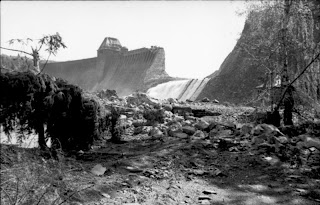
Aftermath of the Eder Dam
Aftermath of the Mohne Dam
On the night of May 16/17, 1943, nineteen modified Avro Lancaster heavy bombers took off from England and started heading toward their objectives. By the time the formations reached the Dutch coast, the flyers had suffered some casualties. Some of the planes were shot down, others released their bombs too early and got caught in the blast of their own bomb. Despite this, successful attacks were made on the Mohne Dam and the Eder Dam, while the Sorpe Dam was damaged without breaching. Only nine out of nineteen planes made it back to England.

In the end, the attacks on the dams of the Ruhr valley caused massive damage both in the loss of hydroelectric power as well as the massive flood damage caused in the valley villages. No mission before or since has ever come close to needing this kind of bravery and guts. In testament to the flyer's courage and sacrifice, a memorial to both the dead and surviving pilots is in Lincolnshire, England. Until next time, take care, and thanks for reading.

Wednesday, September 7, 2011

A Forgotten Winter: The Russo-Finnish War

If someone who did not have more that a cursory understanding of the chronology of World War II, they might pick up a history book, come across a section on the Soviet war with Finland, and say, "There was a war in Finland?". Indeed, the war in Finland is not often brought up when trying to conjure up images of World War II. However, the Russo-Finnish War would prove to show not only the resilience of the nation of Finland, but also of the inadequacies of the Red Army, a fact that Hitler would've been very interested in when planning his Operation Barbarossa.

Almost three months after the invasion of Poland by the Germans, and later the Soviets, in September 1939, Joseph Stalin saw an opportunity to expand his territory. Bordering the Soviet Union were the three Baltic states, Lithuania, Latvia, and Estonia, and the Scandinavian country of Finland. The three Baltic states, under pressure from the Soviet diplomats, signed over their countries to the Soviet Union without a fight. However, Finland was not so eager to give in. They figured that their position so far north gave them enough natural barriers to invasion that their meager armed forces could easily make up the difference. Because Finland had gained territory after World War I that Russia had received almost 200 years earlier, Stalin was willing to try his luck.

The Red Army invaded Finland on November 30, 1939. At first, Stalin encountered little resistance and thought he would easily win. This did not last long at all, though. The Finnish forces fought furiously to defend the Mannerheim Line, as it was called. The extreme Finnish resistance brought diplomatic applause and support from the UK, France, the US, and Sweden. The USSR, on the other hand, was banished from the League of Nations upon their invasion.

The Finnish army took advantage of several flaws in the Red Army, to an astonishing degree. First, after the Great Purges of 1936/37, almost all of the Red Army's most experienced leaders were either dead or in prison,leaving inexperienced leaders in charge of the troops. Second, the Soviets had almost no ski troops, while the Finnish army had nearly grown up on skis and knew how to fight on them. In some cases, entire units were completely massacred, with ski troops machine-gunning troops on their way past, and quickly planting gas bombs on Soviet tanks.

Nevertheless, despite the Finns' proud hearts and strong resolve, they just couldn't compete numerically. Also, the countries that supported them before were either unwilling to give them any substantial aid, or were unable because of their neutrality, as was the case for the US and Sweden. On March 13, 1940, the Finnish Prime Minister was forced to sign the Treaty of Moscow, which gave the USSR 11% of Finland's prewar gains and 30% of Finland's resources. Also, crucially, it gave Leningrad a buffer of territory, which would be put to good use during the siege later on.

While the Russo-Finnish War is not often referred to when thinking about World War II, it is important to note that nearly all of the problems with the Red Army revealed during the conflict remained largely unfixed, right up until Germany's invasion in 1941. This led to the near collapse of the Red Army, were it not for Hitler's misguidance. Until next time, take care, and thanks for reading.