Monday, June 6, 2016

The Magnificent Eleven: D-Day's Famous Photos

One of the eleven frames from D-Day. Photo sourced from WikiCommons.

Today is the 72nd anniversary of the D-Day landings in Normandy. Those who think of D-Day often picture the opening scene of Steven Spielberg's iconic film "Saving Private Ryan" (or, "The Longest Day", for those of the older generations). Aside from first-hand accounts, the knowledge to film those scenes successfully had to come from somewhere, and we are fortunate to have any photos of D-Day at all.

Omaha Beach is where "Saving Private Ryan"'s scenes take place, and it is where the heaviest fighting occurred on D-Day. It is also where Robert Capa, combat photographer for Life magazine, found himself riding along in the landing craft with the second wave of troops.

Wading through the water, ducking behind steel obstacles, and eventually a disabled tank, Capa was snapping pictures left and right, totaling four rolls of film, 106 frames.

Capa made it back on one of the returning landing craft, holding his film bags over his head to prevent the film from getting wet. Upon the film reaching London, it was rushed to be developed. In the film technician's haste, 95 of the 106 frames were destroyed when the drying locker was set too high and the emulsion was melted away (this account of how the film was destroyed is still the subject of debate).

Of the 11 remaining frames, all are slightly out of focus. This is usually attributed to Capa's hands shaking in the intensity of the battle, intensity which the photos have immortalized and embody the horror of war that we must never forget. Until next time, thank you for reading.

(Information sourced from Wikipedia and The Daily Mail.)

Wednesday, March 16, 2016

70 Years Ago: Hermann Goering Takes the Stand

Goering (first row, far left) during the Nuremberg Trials
While 2015 was a year of important milestones from World War II, there were still significant events that took place in the aftermath of V-E Day. One such notable event was the Nuremberg Trials, and seventy years ago this month Hermann Goering, considered the most important surviving Nazi official after the war, would stand to atone for his country's crimes.

A little context is important before the trial: in April of 1945, Berlin was surrounded by the Soviet Red Army. What few German fighting forces were left were battling Soviet forces to the death while many more were almost eager to surrender to American, British, and French forces to escape Soviet occupation.

With Berlin under siege and Hitler more or less sealed in his bunker underneath the Reich Chancellory, Germany's defeat was inevitable, and while no one in the German High Command spoke it aloud, there were concerns about who would assume command of the Nazi government once Berlin fell, since Hitler had repeatedly stated his unwillingness to leave the capital city.

Goering had held the rank of Reichsmarshall since 1940, with Hitler the year before declaring Goering to be his successor. However, as the war turned against Germany, Goering made many promises about 'his' Luftwaffe's abilities that it could not keep, such as failing to break the back of the Royal Air Force and failing to keep the surrounded 6th Army at Stalingrad supplied via airlift indefinitely. These and other failures led to Hitler losing all faith in his old friend as his mental state deteriorated along with Germany.

This led to Goering spending more time outside of Berlin around the time it was encircled. When the communications lines between Berlin and the rest of Germany began to break down, Goering rightly assumed that the capital was going to fall. With this in mind, Goering attempted to enact earlier plans which would transfer command of Germany's armed forces to himself.

However, Hitler got wind of this and assumed that Goering was trying to take power away from him. Outraged, he rewrote his will to place Admiral Karl Doenitz, head of the Kriegsmarine (navy) to be the next President of Germany, with Joseph Goebbels, head of the Propaganda Ministry, becoming the next Chancellor. After Hitler and Goebbels committed suicide on April 30, along with many high ranking Nazi officials, Germany officially surrendered on May 8th, along with Hermann Goering.

When the Nuremberg Trials began in November of 1945, even though Doenitz was officially the highest surviving German head of state, Goering was the highest ranking Nazi that the Allies managed to capture alive. Becuase of this, much emphasis was placed on his testimony, which took place through much of March 1946. He was tried for not only indiscriminate bombing done by the Luftwaffe but also for all of the Nazi atrocities such as the Holocaust.

When he was declared guilty, he requested that he be shot rather than hanged like many of the other condemned war criminals, but his request was denied. In the end, before his sentence was to be enacted on October 15, 1946, he committed suicide with a smuggled in cyanide capsule. None should forget the atrocities committed by the Nazis, and to this day there are still former Nazis who are being pursued for their roles in these tragedies. Nothing can change what happened, but just as in 1946, justice and peace of mind for the survivors, their descendants and the rest of humanity must be sought. Until next time, thank you for reading.

(Photo sourced from Wikipedia. Information sourced from "Illustrated History of the Third Reich" by Alex Cook and "World War II" edited by H.P Willmott, Robin Cross, and Charles Messenger)

Saturday, March 12, 2016

The Elections of Roosevelt, Before and During Wartime

1944 portrait of FDR (1)(small).jpg
Franklin Roosevelt
It's turning out to be a turbulent year in the United States, mostly because of the presidential election. With vastly differing ideologies and stated visions for the country's future direction, voters are going to end up deciding what choices our country makes, both at home and abroad: whether to focus on rebuilding our country and not get involved in world affairs or to dive head-first into a world tearing itself apart with shifting alliances and blood being spilled. Finally, voters will have to decide whether to elect a candidate that might not take the country down the best path but it would be historic nonetheless.

If this sounds like 2016, then you are only partially right. The truth is, this situation is one our country has faced before. In 1940, the United States found itself staring at a world that was tearing itself apart, and we as a country were reluctant to get involved.

By this time, mainland Europe had been overrun by Germany and Great Britain was feeling very much alone in the face of a possible invasion as well as constant aerial attacks. Britain was in desperate need of war materiel and looked to the United States for aid. They would get it, but not without controversy.

Wendell Willkie
Franklin Roosevelt was nearing the end of his second term. The country was slowly pulling out of the Great Depression, but there was still much rebuilding to be done. At this point, there was no law that limited presidents to two terms, although it was a standing tradition since George Washington refused to run for a third term. On the Republican side, an unlikely Wall Street candidate named Wendell Willkie, a former Democrat who supported Roosevelt's 1932 election but now was a critic of his policies towards monopolies in the electric industry, was rising to fame and gained a surprising amount of support.

Roosevelt surprised many, including his own party, when he finally announced he would run for a third term. Roosevelt ran on a platform that sounded very similar to Woodrow Wilson's 1916 campaign promise America will not be drawn into another World War. While many were dubious about whether this promise would be kept, many more worried about Roosevelt's deal with Britain for their purchase of arms, and later the enactment of Lend-Lease. In fact, Churchill respected Roosevelt's pleas not to publicly say anything that implied America would be dran into the fighting until after the election.

In the end, Roosevelt capitalized on his Depression-era popularity and his campaign promises to pursue foreign policies that kept America out of the fighting to a 55%-45% victory over Willkie. However, since the war overlapped with the next election year, 1944, Roosevelt was again faced with re-election, this time for his fourth term.

ThomasDewey.png
Thomas Dewey
This time, though, there was no formal opposition on the Democratic side against Roosevelt, as by that time the war seemed to be drawing to a close. On the Republican side, Thomas Dewey was nominated on the anti-New Deal and smaller government platform, but the current system was working too well for that route to stand much of a chance. Roosevelt won re-election with a comfortable 54%-46% victory.

However, rumors during the campaign of Roosevelt's declining health, while never confirmed at the time, turned to reality on April 5, 1945 with his death just six months into his fourth term. Roosevelt's death dealt a heavy blow to American morale, since many alive at the time could not remember having another president. This directly led to the ratification of the 22nd Amendment in 1947, which limited the presidency to two terms.

What conclusions can be drawn from these two elections? Well, we know that history is made every day, but some things are more historic than others. Also, some things can only be seen as good in hindsight. Just imagine if we as a nation had isolated ourselves from the world's problems. Would we have been drawn into the war at Pearl Harbor again? Maybe not, but if we didn't take the steps we did, then what would the world we live in today look like? Until next time, thank you for reading.

(Photos sourced from Wikipedia. Information sourced from Wikipedia and Inferno: The World at War 1939-1945 by Max Hastings)

Friday, May 8, 2015

V-E Day: 70 Years Ago Today

Soldiers raise the Soviet flag near the Brandenburg Gate
upon Berlin's surrender on May 2. Photo obtained from Wikipedia.
There are seminal dates that are forever associated with events in World War II. December 7 will always be, in Franklin Roosevelt's words, "a day that will live in infamy", as it was the day that Japan attacked Pearl Harbor and brought the United States into the war in 1941. June 6, the day General Dwight D. Eisenhower told his troops to "embark on the Great Crusade, toward which we have striven these many months" on the beaches of Normandy, France.

May 8 may not be as well-known in the minds of popular American culture, but is an important day nonetheless: Victory in Europe Day, the day that Germany surrendered and World War II ended in Europe.

Of course, this day is somewhat deceptive. There were several steps that led up to the surrender. By the middle of April 1945 the Red Army had completely surrounded Berlin, Germany's capital. Within two weeks of heavy bombardment and bloody street to street fighting Berlin was in ruins, and on April 30, Adolf Hitler committed suicide, along with many of the Nazi Party's highest officials including Joseph Goebbels.

Hitler had bequeathed the leadership of what remained of Germany to Admiral Karl Doenitz, the head of the German Navy, slighting Hermann Goering, head of the German Luftwaffe and Hitler's next in line whom Hitler had practically disowned in the war's final months.

Fighting would continue in pockets around Germany for another week, as many of the remaining combat units were SS fanatics clinging to Hitler's last order to not surrender. On May 2 Berlin officially surrendered to the Soviets, leading to surrenders in other small pockets of resistance. By May 5 Soviet troops had reached the outskirts of Prague, capital of then-Czechoslovakia and the last pocket of organized German resistance.

The formal declaration of surrender was signed on May 7 in Reims, France on behalf of the German Army. General Alfred Jodl, head of the German High Command, signed for the Germans. This was repeated in Berlin on May 8 for a very important reason.

The Big Three, the US, Great Britain and Soviet Union, had agreed to only accept Germany's unconditional surrender as one unified power, and had agreed to a draft of the surrender. However, the copy signed in Reims was slightly different than the agreed-upon draft, and the Soviet representative, General Susloparov, was apparently not authorized to accept the surrender on behalf of the Soviet Union, hence two ceremonies and why May 8, not the day before, is considered the official V-E Day.

However, fighting continued in Prague until May 11, which would seem to indicate that May 11 is the 'real' end to the war in Europe. Whatever the real date may be, V-E Day should be remembered as the day that the greatest conflict Europe has ever seen came to an end.

Thank you for reading, and have a pleasant day.

(Events and dates sourced from "Campaigns of World War II Day By Day" by Chris Bishop and Chris McNab)


Thursday, September 5, 2013

WWII Movie Review: "Battle of Britain"

"Never in the field of human conflict was so much owed by so many to so few", are some of the most famous words spoken by British Prime Minister Winston Churchill, in recognition of the monumental effort of the Royal Air Force in repelling the German Luftwaffe, which in turn prevented the German invasion of Britain.

The 1969 film "Battle of Britain" was the attempt to capture this effort and memorialize the brave men who fought in the battle. With an all-star cast featuring Michael Caine, Robert Shaw, Curt Jurgens, and Laurence Olivier, this film has the recipe to blow the audience away with epic performances.
German bombers begin to bomb British airfields on Eagle Day
 (screenshot)
Some interesting facts about this film are that nearly all of the planes used in this film are actual vintage planes (with the exception of the Junkers 87 Stukas, which were 1:2 scale RC models). Also, in filming this movie, the amount of (blank) ammunition used in all of the takes the director ordered exceeds the amount of ammunition that was used in the actual battle!

Nevertheless, there are some problems with this film. The brief romantic scenes in this movie, meant to show the personal strain the battle had between pilots and their wives and lovers, seemed to be thrown into the mix and not done very well, at times appearing to be an afterthought of the scriptwriters to make this picture something more than a pure war picture, and therefore drag down the picture as a whole. Also, some of the aerial combat scenes tended to be drawn out a bit too long.

Overall, though, this film is a staple for any World War II movie library, as it does a fantastic job in honoring the soldiers who lived and died in the skies above Britain on both sides. Until next time take care, and thanks for reading.

(Image fair use rationale: 1. This image is being used to illustrate the article on the movie in question and is used for informational or educational purposes only. 2. This image is of low resolution. 3. It is believed that this image will not devalue the ability of the copyright holder to profit from the original work. 4. No alternative, free image exists that can be used to illustrate the subject matter.)

Tuesday, July 30, 2013

Georg Gaertner: The German Who Got Away

In a couple of my previous posts I have talked about the lauded successes of the Allied prison breaks from German POW camps and the few who made it all the way home. This story, however, is of a soldier from the other side and has a far less pleasant ending. His name is Georg Gaertner, and his name is Dennis Whiles. One identity is real, the other fake. Today, even the man himself has a hard time reconciling which is which.

Gaertner was a soldier serving in the Afrika Korps and was captured in Tunis in 1943. He was sent to a POW camp in Deming, New Mexico where he spent the remainder of the war. Upon the war's end, the Germans were going to be shipped to their homes. However, Gaertner knew that his home was in the Soviet zone of occupation and later ceded to Poland, where Germans in the region were pressured out.

Gaertner managed to escape in May of 1945 and spent the next 40 years on the run, assuming the identity of Dennis Whiles. He spent these years trying to live a quiet American life, even marrying. His circumstances finally forced him to confess his true identity to his wife, and later to the country in 1985. Until that point, Gaertner/Whiles was one of the top fugitives on the FBI Wanted list, with his POW picture posted in almost every post office in the country.

Whiles, having spent 40 years suppressing his birth identity, has spent the last 23 years trying to rediscover his past life. He is 93 now, and lives alone in Boulder, Colorado. Until next time take care, and thanks for reading.

(For further details on Georg Gaertner, watch "Hitler's Lost Soldier" from 2006.)

Thursday, June 6, 2013

Ghost Army: The First US Army Group

Today is the 69th anniversary of the Normandy landings and one of the defining moments of World War II. Many thousands of brave men died on the beaches due to heavy German resistance in some places, especially Omaha Beach. However, many more men may have died, and indeed the invasion may not have succeeded were it not for Operation Quicksilver: the Allied intelligence operation intended to draw German units away from Normandy and otherwise confuse the Germans into thinking the invasion was going to happen somewhere else.

While the main invasion was at Normandy, the Germans
believed it would come at Pas de Calais to the north.
Map obtained from WikiCommons.
The thinking behind this operation is clearly shown in the 1970 film "Patton", because General George Patton would play a vital role in the deception. In the midst of the fallout from Patton slapping a battle-fatigued soldier in front of the press, Patton was removed from command of the Seventh Army and temporarily relieved of duty.

However, the Germans followed his movements very closely, due to their belief that he was the Allies' best commander and he would be in charge of the eventual invasion of Europe. The Allies sought to use this and placed Patton in 'command' of the First US Army Group.

The group was, in fact, completely fictitious. However, through the use of staged radio traffic, mock-up vehicles to fool air reconnaissance, occasional real units moving in and out of the group, and turned German double agents relaying false information to the German High Command made it seem that the main invasion would come at the Pas de Calais, the closest point in the English Channel (it is possible to see the White Cliffs of Dover from France at this point).

This eventually led to the redeployment of several German units, including the majority of the Panzer units in western Europe, away from Normandy. When the invasion finally came, Hitler and the High Command believed that it was a diversion and the 'real' invasion would still come from Calais.

So successful was this deception that the men who worked to create it would go on to do several diversionary 'performances' in Europe. Their exploits have recently been declassified and can be seen in the new documentary "The Ghost Army" available through PBS. Until next time take care, and thanks for reading.

Wednesday, May 1, 2013

Trent Park and Candid German Generals


Watch Bugging Hitler's Soldiers on PBS. See more from Secrets of the Dead.
One of the most exciting things that a historian can have happen to them is to discover something that had been lost to history and adds to the understanding of an event. Such is the case with the discovery of 50,000 pages of transcripts from secretly recorded conversations between captured German generals about various aspects of the war.

As the episode of "Secrets of the Dead" describes, great trouble was expended to catch the German generals that the British had captured in giving away some morsel of important information in casual conversation that could change the course of the war. Such information included the confirmation of the existence of the V-2 rockets, the deep divide between the Germans loyal to Hitler and those who weren't, and tragically the deep extent of the Holocaust atrocities.

These files had been buried because the British did not want to reveal the effectiveness of their surveillance techniques in the atmosphere of the Cold War. They were recently rediscovered by accident by a German historian in the Royal Archives in London. This is what historians mean when we say that we aren't done making discoveries about the war, we haven't learned all there is to know about the war, and this is very exciting for us. Until next time take care, and thanks for reading.

Stars and Stripes Review: May 6, 1945

Scanned by Cody Lizotte.
This issue of The Stars and Stripes is interesting in that it was published two days before Germany's surrender, known as V-E Day (Victory in Europe). Of course, at that time they didn't know the exact day the Germans were going to surrender. After all, the Germans had been facing their ultimate defeat for the last two years, ever since the Germans lost their strategic offensive capability on the Eastern Front.

As shown in the headline, the Germans were still fighting like warriors right up to the end. Their last pocket of armed resistance was growing smaller and smaller. Elsewhere on the continent, the war was not over yet. German forces had captured Norway in 1940 and now that Germany was effectively in Allied hands this is where the leaders of German resistance were holed up, including Grand Admiral Karl Doenitz, the successor to Hitler after his April 30 suicide. In the article on Norway, it mentions that Swedish officials regarded rumors of German capitulation in Norway to be "premature". Little did they know...

Of course, the fighting was still far from over in the Pacific, where V-J Day wouldn't come until August of 1945. However, for a historian looking back on this issue, it's cool to see the reports of continued German resistance and to think that the people who wrote those articles had no idea that the war in Europe was that close to being over. Until next time take care, and thanks for reading.

Tuesday, April 30, 2013

The Main Challenge For World War II Historians

One of the greatest questions that historians face in any field of study is "what was this person thinking before X happened?" Often times historians are forced to make educated guesses based on the person's actions as to what their motivations are.

However, sometimes historians have documentation from a person to give us a glimpse into their mindset during an event. In the field of World War II research, we are fortunate to have some very interesting and enlightening perspectives into two of the war's combatants: Britain and Germany.

Of course, the person that people most want to get into the mind of is Adolf Hitler. Fortunately for historians, Hitler was an avid orator and there are numerous works of his that explain his motivations. People who at the time viewed Germany's aggressive actions as a shock obviously didn't read "Mein Kampf", in which Hitler states that:

"[the Nazi movement] must find the courage to gather our people and their strength for an advance along the road that will lead this people from its present restricted living space to new land and soil, and hence also free it from the anger of vanishing from the earth or of serving others as a slave nation."

Friday, April 26, 2013

Arado Ar 234: First Jet Bomber

File:Arado 234B 2.jpg
An Arado Ar 234 after the war with US markings.
Photo sourced from WikiCommons.
As World War II neared its conclusion in Europe, the Germans were growing increasingly desperate for "wonder weapons", weapons that could turn the tide of war in their favor. Nothing the Germans developed did that but they greatly advanced the field of military technology. One of these technological innovations was the implementation of the jet engine in both fighters and bombers. The fighter was the Messerschmitt Me 262, the bomber was the Ar 234.

The first Ar 234s were introduced in the fall of 1944. At first they were only used in a reconnaissance capacity, but soon they were used as bombers. Since the bomb bay was completely filled with fuel tanks, the bombs had to be mounted externally, an unusual trait for such a plane. Even so, the few missions the Ar 234 flew proved that the plane was nearly impossible to catch (see Bombing of Remagen Bridge)

However, like all of Germany's secret weapons it was too little too late. The early jet engines needed a lot of fuel that wasn't available and Allied pilots figured out that the easiest time to shoot down a jet was to wait for it to take off or land, which happened on many occasions. Nevertheless, the innovations made by the Germans in the field of jet aircraft paved the way for all modern jet aircraft today. Until next time take care, and thanks for reading.

(Fcts sourced from "The Encyclopedia of Aircraft of World War II" edited by Paul Eden as well as Wikipedia on the Ar 234)

Wednesday, April 24, 2013

WWII Movie Review: "A Bridge Too Far"

Photo sourced from
WikiCommons.
It was the largest operation on the Western Front since the D-Day landings. It was the largest airborne assault in history up to that time. It was also the big disappointment for the Allies who thought that they could end the war before Christmas 1944. This was Operation Market Garden, and it was immortalized by the 1977 film A Bridge Too Far based on the 1974 book by Cornelius Ryan.

The film is famous as a movie because of its large number of all-star actors, including James Caan, Robert Redford, Michael Caine, John Ratzenberger, Laurence Olivier,  and Sean Connery. This was not the first World War II film to feature some of these names in one place (see The Longest Day).

However, as a historical film it outdoes itself. Based on the book of the same name by Cornelius Ryan, this movie is incredibly accurate in its portrayal of the ultimate failure of Market Garden and the people associated with it on both sides, with few obvious artistic liberties.  Filming for the most part took place on the sites where the actual events happened, most notably the Arnhem bridge.

This is not the shortest film at almost 3 hours, but for the time you commit to watching this it gives you a good taste of one of the most notorious campaigns in World War II and overall it's a great war movie. Until next time take care, and thanks for reading.

Saturday, April 20, 2013

The Bridge at Remagen: First Jet Bomber Target in History

An Arado Ar 234 as seen at the National Air and Space Museum's
Steven Udvar-Hazy Center. Photo by Cody Lizotte.
In early 1945, the majority of Germans all but knew they were done for. The Luftwaffe's attempts to break the Western Allied air forces, Operation Bodenplatte, was a disaster. Soviet troops had captured almost all of occupied Poland and were closing on Berlin. Finally, the Western allies had reached the Rhine River, the natural border between France and Germany.

The Wehrmacht (German army) had failed in their mission to blow up the main bridge across the river at Remagen, so the Luftwaffe (German air force) was ordered to launch bombing strikes to destroy the bridge. Suffice it to say, the Allies were well prepared to fend off air attacks and the strikes were unsuccessful. The Americans captured both sides of the bridge by March 23, 1945.

However, this was the first instance in history when formations of only jets were used to strike a target. The escort fighters were Messerschmitt Me 262s, the world's first operational jet fighter. The bombers were Arado Ar 234s, the world's first jet bomber with a bomb payload equal to that of the B-17 Flying Fortress but with a top speed at least 150mph faster.

The raids may not have been a success, but this early mission would later serve as a blueprint for future air strikes in the jet era, with F-18s escorting A-10s for example. Until next time take care, and thanks for reading.

(Facts sourced from "Campaigns of World War II Day by day" by Chris Bishop and Chris McNab)

Wednesday, April 17, 2013

Luftflotte 4: Lifeline of the German 6th Army at Stalingrad

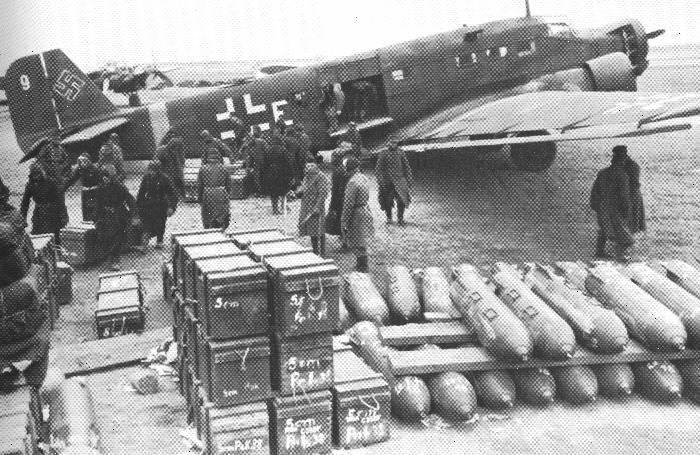
A Junkers Ju52 being offloaded at Stalingrad.
Photo sourced from www.stalingrad.net.
One of the US Air Force's proudest moments in postwar history was the Berlin Airlift, a massive undertaking in which the Soviet-besieged city of West Berlin was supplied solely by air for over a year. A similar feat was attempted during the war by the German Luftwaffe in order to supply the surrounded Sixth Army at Stalingrad.

In 1940, with the British Expeditionary Forces and the remnants of the French army fleeing to the coast near Dunkirk, Hitler ordered the advancing forces stopped. This was partly because they had outrun their supply lines, but also because Herman Goering, the head of the Luftwaffe, promised Hitler that he would demolish the enemy using nothing but air power. Needless to say, it didn't work nearly as well as Goering had hoped.

You would think Hitler would have lost faith in Goering after that, but no. In November of 1942, Goering made a promise to Hitler that using Junkers Ju 52s from Luftflotte 4 he could supply the surrounded Sixth Army with enough resources to drive back the Soviets. This worked in that it allowed the Sixth Army to hold on longer than was expected, but because of increased Soviet air superiority and the fact that the Soviets were capturing the airstrips near Stalingrad meant that the airlift was overall a disaster. The last plane left Stalingrad on January 24, 1943, and the Sixth Army surrendered ten days later.

The toll on Luftflotte 4 was tremendous, with one-third of the entire fleet of Ju-52s on the Eastern Front destroyed. Nevertheless, one good  thing came from this airlift. About 42,000 wounded troops were evacuated and were spared the harsh prisoner of war camps that awaited the remnants of the Sixth Army. Until next time take care, and thanks for reading.

(Facts and figures sourced from "World War II" by H.P Willmott, Robin Cross, and Charles Messenger as well as Wikipedia on Hans-Georg von Seidel, the Luftwaffe head of logistics during this operation.)

Friday, April 12, 2013

Stars and Stripes Review: July 29, 1943

Scanned by Cody Lizotte.
For those of you who are unfamiliar with this, The Stars and Stripes is the daily publication for the U.S armed forces and has been published since World War I. It has been published both as a traditional newspaper and a tabloid. Today, many issues of Stars and Stripes that denote famous wartime events are highly sought, such as D-Day and "Hitler Dead". This issue, however, does not show any events of major historical importance, but is instead a unique insight into the everyday reality of World War II.

This specific issue was published in London, however as the war progressed other editions sprang up such as North Africa, Paris, and Munich, Germany. This issue's headline topic concerns the Allied policy of the Combined Bombing Initiative, where the Americans would bomb Germany during the day and the British would bomb during the night.

Also included in this issue are the first signs of strains between Germany and Italy. As peace talks begin, Italy is seen as willing to surrender to the Allies, an act that they won't commit until the Allied invasion of mainland Italy (at the time of this issue, the Germans had yet to be defeated in Sicily).

Along with various war-related stories, there's also the full-page sports section (the issue's only one sheet of folded paper, with sports being on page 3 and the other pages dealing with war issues) reporting the results from the minor leagues of baseball as well as an upset for the Phillies as the Cardinals beat them 6-2 and 5-2, leading to a replacement of the Philies' manager.

Finally, there's the comics. There are only two strips in this issue (sometimes there's at least five), and neither of them are in circulation today: Li'l Abner and a 'new' one Terry and the Pirates. These strips follow the model of serials rather than witty one-offs every day. However, for the men in the trenches it was a refreshing break from the harshness of war. Until next time take care, and thanks for reading.

Thursday, April 11, 2013

Autogyros: WWII's Contribution to Helicopter Development

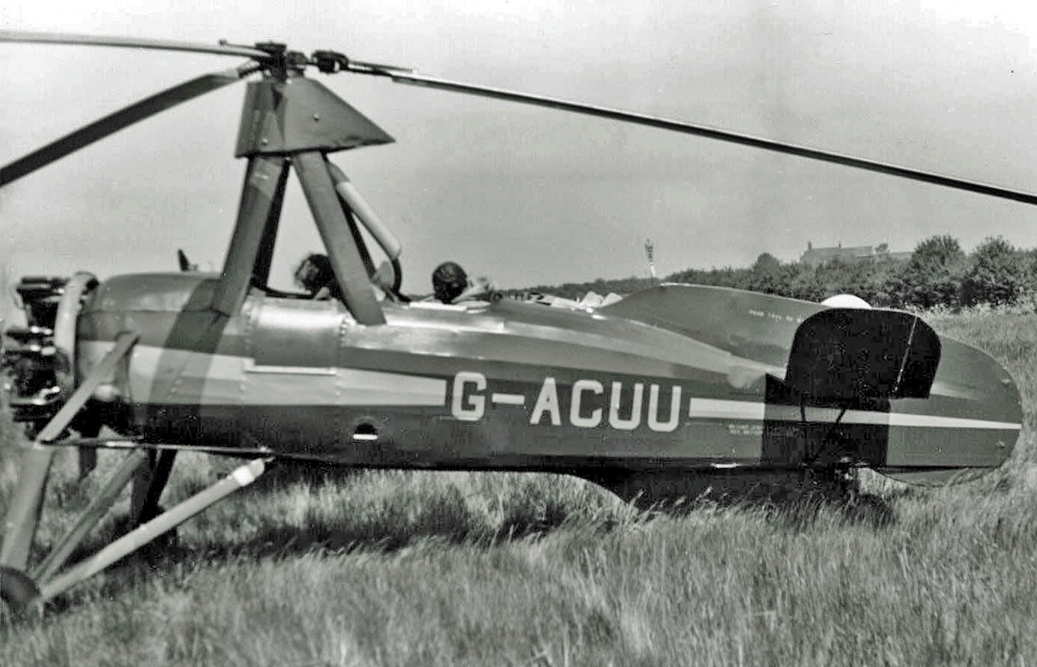
A Cierva C.30 circa 1951. Photo sourced from WikiCommons.
All technology has to start somewhere. Before we could get to images of Bell Hueys depositing U.S troops in Vietnam, we had to have several generations of helicopters developed, as well as find various military uses for such aircraft. Before even the spartan helicopters seen on "M*A*S*H", we had the autogyro, and it played a small but vital role in World War II and afterward.

The autogyro was first successfully flown in 1923. In concept it's similar to a helicopter in that it has a rotary wing that provides lift. Unlike a helicopter, for an autogyro to achieve lift it must have a propeller push it forward, making the rotor spin in the wind fast enough.

The autogyro was adopted by the air forces of both Germany and Britain because of its low maintenance requirements and its short takeoff requirements. The Germans used autogyros as reconnaissance tools to aid the U-Boat hunting packs off the coast of mainland Europe. The British, however, used autogyros like the Cierva C.30 to calibrate the coastal radar installations that were so crucial during the Battle of Britain in 1940.

While this was the main extent of autogyros in World War II, it was through experimentation on these aircraft that helicopter pioneers like Igor Sikorsky were able to make the breakthroughs necessary to make the first operational helicopters in the late 1940s. The rest, as they say, is history. Until next time take care, and thanks for reading.

(Facts sourced from "World War II" by H.P Willmott, Robin Cross, and Charles Messenger, as well as Wikipedia on autogyros.)

Saturday, April 6, 2013

Schweinfurt: The Mission All Pilots Hated

An aerial view of Schweinfurt during the raids in 1943.
Photo sourced from wikicommons.
One of the hallmarks of World War II is the image of massive bomber formations heading into Germany to bomb factories and cities in order to cripple the German war machine and destroy morale. However, these missions were fraught with peril from anti-air flak on the ground and enemy fighters in the air. One such mission was more perilous than most, but the target was vital, if not immediately obvious as to its importance. The factories at Schweinfurt made extremely vital, immensely important...ball bearings.

These ball bearings, however, really were vital in the German war effort, especially in their aircraft production and specifically in the manufacture of airplane engines. It was thought that the destruction of the Schweinfurt factory would cripple the German aircraft industry and promote Allied air superiority.

However, this raid earned a reputation in its first incarnations. In August and October of 1943, the Allies did two raids on Schweinfurt with over 200 bombers per raid. Normally, the acceptable amount of battle losses for a bomber mission is below 10 percent. On these raids, the casualty rates were as high as 30 percent. After the October raid, strategic bombing in Europe was suspended for four months to recover from the losses.

Schweinfurt would be visited again and again until the factory was destroyed, costing the Germans 25 percent of their entire ball bearing making capability. However, lack of proper intelligence and no air superiority fo rthe Allies meant that these raids were the most costly and the most infamous of the war. Until next time take care, and thanks for reading.

(Facts and figures sourced from "Campaigns of World War II Day by Day" by Chris Bishop and Chris McNab)

Thursday, April 4, 2013

Wartime Innovation: The Tank Destroyer

A Hetzer on patrol in Hungary 1944.
Photo sourced from WikiCommons.
In war, there's a certain amount of innovation associated with certain situations. Technology is often developed at a much faster rate than in peacetime, and new technology is often produced as a result. One of these new technologies is the tank destroyer.

Developed later in the war, the tank destroyer is basically a tank gun mounted on an obsolete tank chassis. The Germans were one of the first to build one of these, and it was called the Hetzer. It was cheaper to produce than a tank with a comparable gun, and as the name implies it could destroy enemy tanks with losses that were easier to replace.

Unfortunately for the Germans, like many of their technological achievements in the war, it was too little too late. While the concept of the tank destroyer would be adopted by other nations and is still used to this day, in World War II it came too late to change the outcome. Until next time take care, and thanks for reading.

(Facts sourced from "Campaigns of World War II Day by Day" by Chris Bishop and Chris McNab)

Saturday, March 30, 2013

Junkers Ju-87 Stuka: Death Screams From Above

A flight of Stukas October 1943. Photo sourced from WikiCommons.
One of the main reasons why Germany was so successful in its early military campaigns was its use of blitzkrieg, or lightning war. In blitzkrieg, the armored units thrust through the enemy lines and sweep in from behind, encircling the enemy forces and cutting off their supplies. One of the key supports for the following infantry was the Luftwaffe and their dive bombers, the most famous of which was the Ju-87 Stuka.

The Stuka was unique in that it had bent gull-wings and it also had a siren attached to it. When the plane dove on the enemy formations, wind would pass through the siren and the plane would be heard shrieking down on its 'prey' right before it released its bomb with pinpoint accuracy. The Stuka, in fact, was one of the best dive bombers the Luftwaffe had in its arsenal.

However, it was after the conquest of mainland Europe that the Stuka's main problems surfaced. When Germany turned its sights towards bombing Britain into submission, the Stuka was one of the main bombers used in that campaign. However, the fact that it was very slow and couldn't maneuver very well in tight turns made it easy prey for the RAF. This made the limitations of the Stuka painfully clear to the Germans.

Eventually the Stuka was phased out of the Western lines and shipped to the Eastern front, where it continued to be used in its ground support role throughout the rest of the war, raining screaming death from above. Until next time take care, and thanks for reading.

(Facts sourced from "The Encyclopedia of Aircraft f World War II" edited by Paul Eden)

Wednesday, March 27, 2013

Escaping is no longer a sport!

In my previous posts about the various prison escapes, I have talked at length about the methods used by the prisoners to outwit their German captors. However, one thing that may still be confusing is why so much emphasis was put on these escapes. The answer is because the prisoners showed immense courage to do what they did, but not only in the act of escaping itself.

The reason so much emphasis is put on these escapes is because of the daring of the prisoners to escape into the heart of a country whose contempt and hate for them grew with every Allied advance. This led Hitler to enact more and more severe punishments for escapees, but still within the bounds of the Geneva Convention, which laid out rules of conduct in war between POW and jailer. these bounds included the prisoner's duty to, in a nutshell, escape and confound the enemy and use an inordinate amount of resources to maintain their confinement.The other big bound was that jailers couldn't kill prisoners.

However, as the war went on Hitler could not afford to tie up more and more resources to round up escaping prisoners. After the Great Escape, where 76 prisoners escaped, an example had to be made. After they chose 50 of those captured to be summarily executed, posters popped up in all of the German POW camps warning the prisoners that if they were caught escaping again they would be killed.

 Even so, many prisoners dared to resist their German captors, although significantly less than in previous years. The prisoners of Stalag Luft III worked on yet another tunnel after the Great Escape, and the prisoners of Colditz built the Colditz Cock glider. These men knew the risks if they were to be caught and they still did these things. This was the kind of courage that legends were made of. Until next time take care, and thanks for reading.

(Sourced from "The Great Escape" by Paul Brickhill and "Colditz: The Untold Story of World War II's Great Escapes" by Henry Chancellor)